
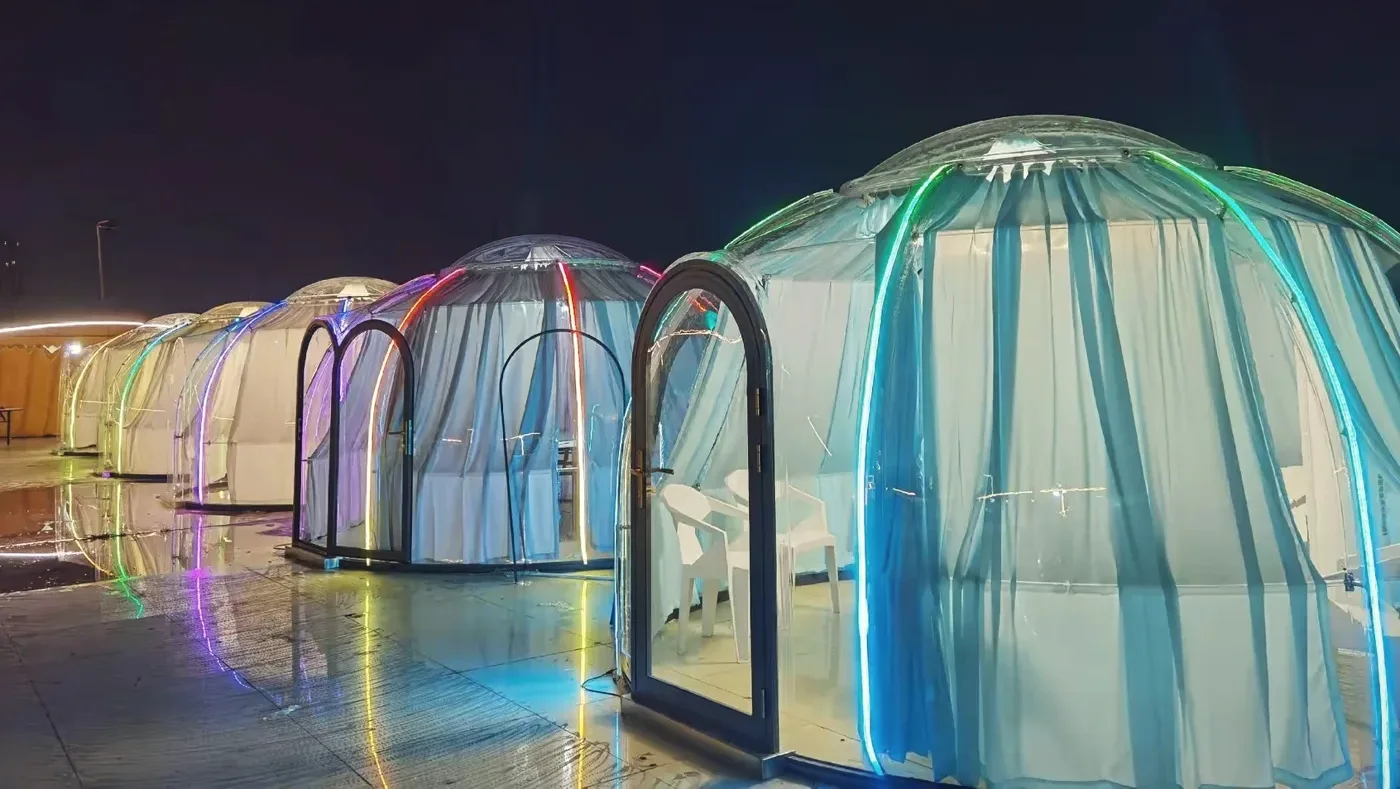
Winter use
Outdoor Igloo Dome for Winter: How to Heat It and Handle Snow
A single-skin clear polycarbonate dome loses heat at about 5–6 W per square metre of shell for every degree of difference between inside and outside. So size the heater from shell area × temperature difference × about 5.5, then add a margin for air leakage and the door opening. Use electric heat rather than a flueless gas heater, keep air moving along the shell, and brush snow off gently. The rigid shell itself stays in service in deep cold; what limits winter use is the heating plan.
Prepared by Linda, Marketing, Domevora · U-values calculated from the thermal conductivity of solid polycarbonate (0.21 W/mK, ASTM C177, Palram PALSUN data) and EN ISO 6946 surface resistances · Hero photo: client installation, cropped and colour-corrected · Updated 23 October 2026
Why it gets cold
The shell is a window all the way round.
A clear dome is one big pane of glazing with no insulated wall or roof. Heat leaves through every square metre of it, and the dome’s main appeal, an open view of the sky, comes from that same single skin. A Domevora shell holds its material properties down to −40 °C; the question in winter is how much heat it takes to keep the room comfortable.
Thicker solid polycarbonate helps less than most buyers expect. The air films on either side of the panel do most of the insulating, so going from 4 mm to 10 mm lowers the U-value by only about 13%.
The number that decides it
U-value of single-skin solid polycarbonate.
| Panel thickness | Wall (sideways heat flow) | Roof (upward heat flow) |
|---|---|---|
| 4 mm | 5.3 W/m²K | 6.3 W/m²K |
| 6 mm | 5.0 W/m²K | 5.9 W/m²K |
| 8 mm | 4.8 W/m²K | 5.6 W/m²K |
| 10 mm | 4.6 W/m²K | 5.3 W/m²K |
Calculated as U = 1 / (Rsi + Rse + d/k), with k = 0.21 W/mK for solid polycarbonate (ASTM C177, Palram PALSUN data) and EN ISO 6946 surface resistances Rsi = 0.13 m²K/W (walls) or 0.10 m²K/W (roof), Rse = 0.04 m²K/W. Wind and night-sky radiation make real losses higher on exposed sites.
Sizing the heater
Shell area × temperature difference × U.
Worked example. Take a dome with 20 m² of shell, 0 °C outside and 20 °C wanted inside. Conduction through the shell is about 5.5 × 20 × 20 = 2,200 W. That is before air leaking round the door and through vents, and before guests opening the door. Add a margin for those, and for the wind on an exposed site, and set the heater to cover the coldest evening you plan to open.
Ask us for the shell surface area of the model you are considering; it is larger than the floor area. Then put your local design temperature into the same sum. For a commercial site, have the local engineer size the heating, the electrical supply and the controls.
Which heater
What works, and what to avoid.
Electric radiant panels or infrared heaters
They warm people and surfaces directly, so guests feel warm even while the air near the shell stays cooler. They add no moisture to the air.
Fan heaters or heat pumps
They move warm air. Aim the flow along the shell rather than up the middle, which also keeps the panels warmer and drier. A floor-standing unit takes floor space, so plan it into the layout.
Underfloor or platform heating
It warms the floor that guests sit and walk on, but it reacts slowly. It works best as background heat alongside a faster heater.
Avoid flueless gas and paraffin heaters
Burning 1 kg of propane releases about 1.6 kg of water vapour, which condenses on the cold shell, and the fumes have nowhere to go in a small enclosed room. If you use combustion heat, use an appliance vented to the outside and follow the manufacturer’s and local safety rules.
Keep heaters away from the shell and from curtains, and follow the clearances the heater’s manufacturer specifies. For condensation, the companion guide how to stop condensation in a clear dome gives the dew point for your room conditions.
Snow and ice
Let it slide, brush it gently, keep the door clear.
- Brush, do not scrape. Use a soft brush or a soft-edged snow rake. Shovels, scrapers and ice picks scratch polycarbonate, and damage from abrasive cleaning is excluded from the material warranty.
- Clear the base and the door. Snow sliding off the shell piles up around the base ring and against the door. Clear it so the door seals and drainage keep working.
- Do not use de-icing chemicals or solvents on the panels. Check any product against polycarbonate compatibility first; a heated room clears the shell from inside.
- Know your snow load. On a snowy site, the structural question is the design snow load, not how cold it gets. See wind and snow for what to request from us and confirm locally.
Buying for winter
What to check in an outdoor igloo dome for winter.
- A shell rated for your coldest night. Ask what temperature the shell material holds its properties to. A Domevora polycarbonate shell is rated down to −40 °C; see climate and comfort.
- A design snow load, not only a cold rating. On a snowy site the structure has to carry the snow that lands on it. Ask for the design snow load and confirm it locally; see wind and snow.
- The shell surface area. Without it you cannot size the heater. Multiply it by the temperature difference and about 5.5 W/m²K, as in the worked example above.
- A power supply for the heater. An outdoor igloo dome with a heater needs a supply sized for that heater, installed and protected to local electrical rules.
- A way to move air. Air moving along the shell keeps it drier; see dome condensation for the dew point at your room conditions.
- A door that seals and a base that drains. Snow piles up against the base ring and the door, so both matter more in winter than in summer.
There is no single best outdoor igloo dome for winter. The right one is the size whose shell area your heater and power supply can cover on your coldest night. For home sizes and prices, see garden igloos.
Questions buyers ask us
Can you use an igloo dome in winter?
Yes. A rigid polycarbonate dome does not need taking down for winter, and the shell holds its properties to −40 °C. Comfort depends on heating: a single-skin clear shell loses about 5–6 W per m² for every degree between inside and outside, so plan the heater from that. On a restaurant or home patio it also works as a temporary winter patio enclosure: the panels unbolt if you move it in spring. How it compares with clear side walls or a tent: winter patio enclosures. Over a hot tub, steam adds to the condensation load; see hot tub domes.
How big a heater does a garden dome need?
Multiply shell area by the temperature difference by about 5.5. For 20 m² of shell with 0 °C outside and 20 °C inside, that is about 2,200 W through the shell alone, before air leakage and door openings. Ask us for your model’s shell area.
Is a gas heater safe in a dome?
A flueless gas or paraffin heater is a poor choice in a small clear enclosure: it adds a lot of water vapour, which condenses on the shell, and its fumes need ventilation. Electric heating, or a combustion appliance vented outside and installed under local rules, is the safer route.
Does a thicker polycarbonate shell keep the dome much warmer?
Not much. For single-skin solid sheet, going from 4 mm to 10 mm lowers the U-value from about 5.3 to 4.6 W/m²K on the walls, because the air films on each side do most of the insulating.
Tell us the model and the coldest night you want to open.
We will send the shell area and the configuration options for that model, so you and your installer can size the heating.