
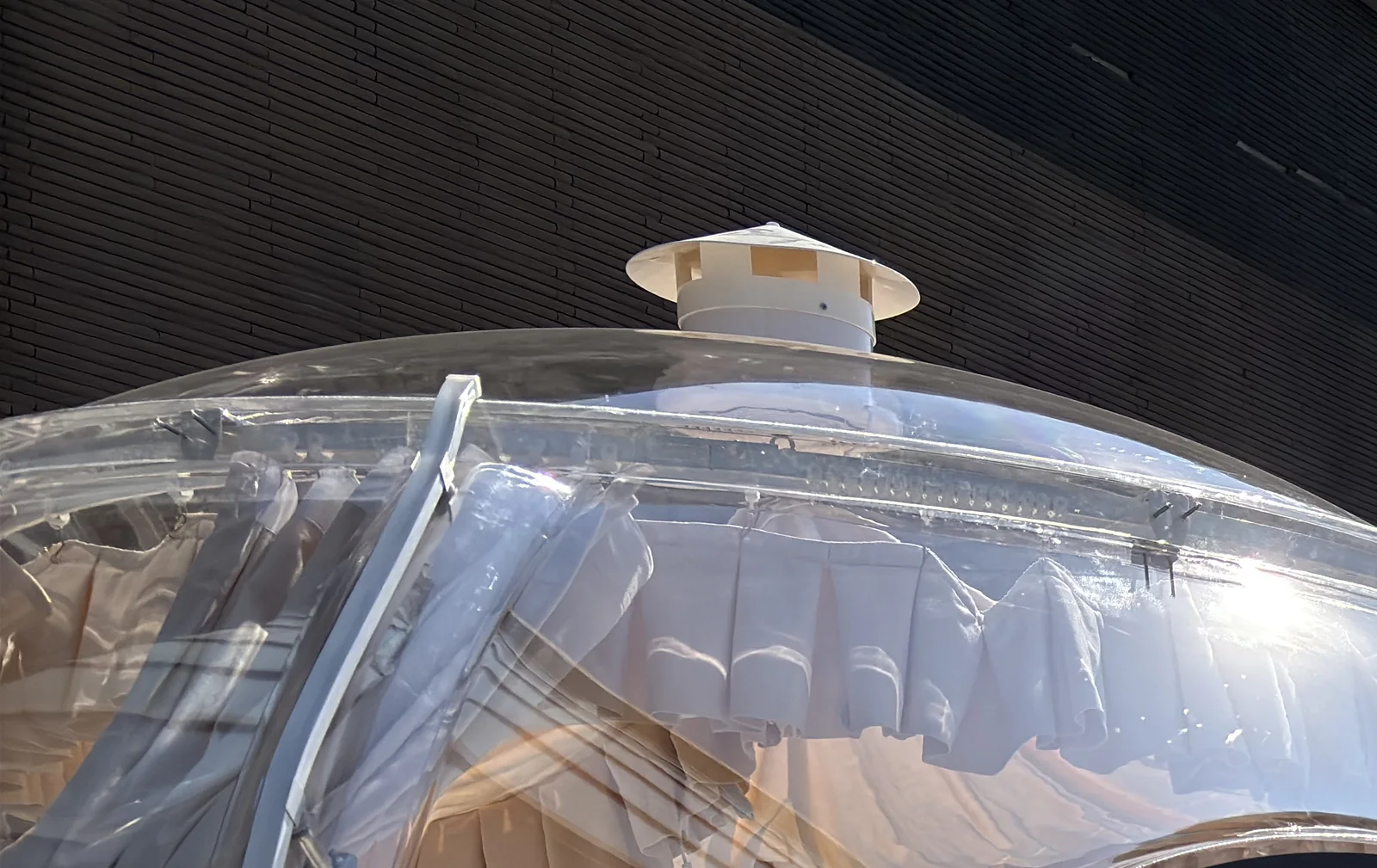
Condensation
How to Stop Condensation in a Clear Dome
Condensation forms when warm, moist air inside the dome touches a shell surface colder than the air’s dew point. You stop it in three ways: remove moisture, mainly by venting at the crown where warm moist air collects; keep the shell surface warmer, with heating and with curtains set back from the wall; and cut the moisture you add, from guests, cooking, hot tubs and flueless heaters. No clear enclosure stays dry in every climate, but most domes can be kept clear for normal use.
Prepared by Linda, Marketing, Domevora · Dew points calculated with the Magnus formula (Alduchov & Eskridge, 1996) · Updated 21 October 2026
Why it happens
The shell is the coldest surface in the room.
A single-skin polycarbonate shell has the outside air on one side and the room on the other, so on a cold evening its inner face sits well below room temperature. Any air that meets it is cooled; if it cools below its dew point, water appears on the panel.
On a clear night the shell also loses heat by radiation to the sky, so it can run colder than the outside air. That is why condensation often shows up after midnight on clear, still nights, even when the evening was dry.
The number that decides it
Dew point: the shell temperature at which water starts to form.
| Room air | 40% RH | 50% RH | 60% RH | 70% RH | 80% RH |
|---|---|---|---|---|---|
| 16 °C | 2.4 °C | 5.6 °C | 8.2 °C | 10.5 °C | 12.6 °C |
| 18 °C | 4.2 °C | 7.4 °C | 10.1 °C | 12.4 °C | 14.5 °C |
| 20 °C | 6.0 °C | 9.3 °C | 12.0 °C | 14.4 °C | 16.4 °C |
| 22 °C | 7.8 °C | 11.1 °C | 13.9 °C | 16.3 °C | 18.4 °C |
How to read it: at 20 °C and 50% relative humidity, water forms on any part of the shell colder than 9.3 °C. Let the humidity climb to 70% and the threshold rises to 14.4 °C, which a clear shell easily falls below on a cool night. Bringing the humidity down from 70% to 50% at 20 °C lowers the threshold by 5.1 °C.
Calculated with the Magnus formula, a = 17.625, b = 243.04 °C (Alduchov & Eskridge, 1996). Measure your own room with a hygrometer; a basic one shows temperature and relative humidity together.
What works
Five measures, in the order that usually helps most.
1. Vent at the crown
Warm, moist air rises to the top of the dome, so an opening there removes it first. If your dome has a crown vent or a top-lift opening, use it; pair it with a low opening, such as a window or the door ajar, so outside air can replace what leaves. Where weather and security allow, leave the crown slightly open overnight.
2. Cut the moisture you add
Guests breathe out water vapour all evening, and cooking, wet coats and plants add more. Flueless gas or paraffin heaters are the worst source: burning 1 kg of propane releases about 1.6 kg of water into the room. Use electric heat, or appliances vented to the outside.
3. Heat the air near the shell
Heating raises both the room temperature and the shell’s inner surface temperature. It works best when the warm air reaches the panels, so place heaters to move air along the wall rather than straight up the middle. For heater sizing, see how to heat a dome in winter.
4. Keep curtains off the wall
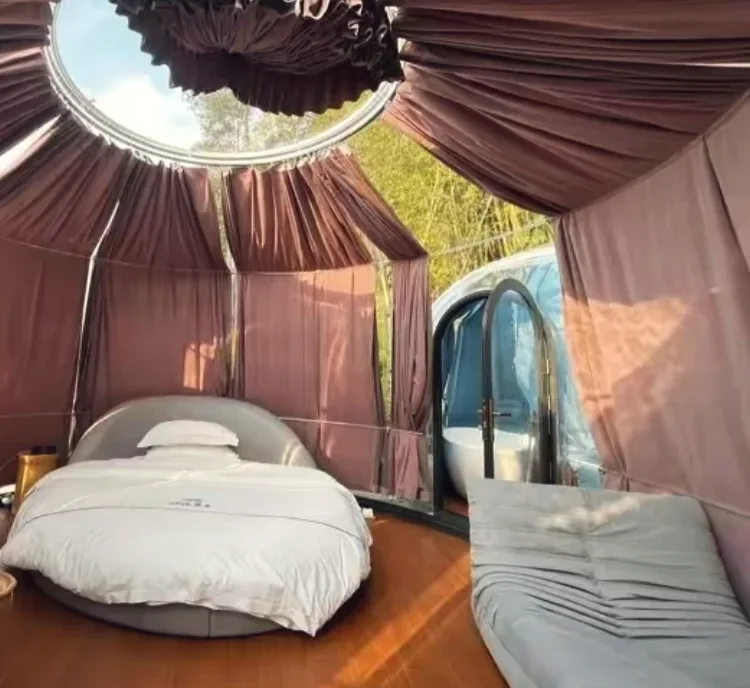
A curtain drawn tight against the shell traps a layer of cold air behind it, and that pocket condenses first. Hang curtains a little away from the panels and open them in the morning so the shell can dry.
5. Dehumidify where air cannot move
In humid climates, or in a dome closed up for days, an electric dehumidifier takes out what ventilation cannot. Empty or drain it, and allow for its floor space in the layout.
Special cases
Hot tubs, dining and closed-up domes.
- Hot tub domes carry far more moisture than any other use. Keep the tub covered when it is not in use and plan continuous ventilation. See the hot tub dome buying guide and the hot tub size check.
- Restaurant domes fill with breath and food steam during a sitting. Vent between sittings, keep hot food covered until served, and see the restaurant dome buying guide for service flow.
- Domes left closed between bookings or over winter should be aired on dry days, with curtains open and the floor dry, so moisture does not build up in fabrics and seals.
Cleaning off the water
Wipe gently: polycarbonate scratches.
Remove condensation with a soft, clean microfibre cloth or a soft squeegee. For cleaning, use clean water and mild soap. Avoid abrasive pads, paper towels used dry, and solvents that are incompatible with polycarbonate: they scratch or cloud the panel and are excluded from the material warranty. Check that the drainage at the base ring is clear, so water running down the panels leaves the dome.
Choosing the shell, vents and shading for a whole climate rather than fixing one problem? See climate and comfort and the vent options on accessories.
Questions buyers ask us
Why is there water on the inside of my dome in the morning?
Overnight the shell cools, often below the outside air temperature on a clear night, while the air inside still holds the moisture from the evening. When the inner face of the shell drops below that air’s dew point, water forms on it. Venting at the crown and lowering the humidity address the cause directly.
Does a heater stop condensation in a dome?
An electric heater helps, because it warms the shell’s inner surface as well as the air. A flueless gas or paraffin heater can make condensation worse: burning 1 kg of propane releases about 1.6 kg of water vapour into the room.
What humidity should I keep inside a dome?
The lower the better for condensation. At 20 °C, 50% relative humidity means the shell must fall below 9.3 °C before water forms; at 70% it only has to fall below 14.4 °C. Measure with a hygrometer and vent or dehumidify when humidity climbs.
Is condensation a sign that the dome is leaking?
Usually not. Condensation appears evenly across the panels, especially high up, and gets worse on cold nights. A leak shows up at one place, at a seam, fixing or the door, and when it rains. If water appears in the same spot only in wet weather, check that seal.
Tell us the climate and how the dome will be used.
Send the location, the use (dining, guest room, hot tub or garden room) and the hours it will be occupied. We will recommend the vent, window and shading configuration for that model.